
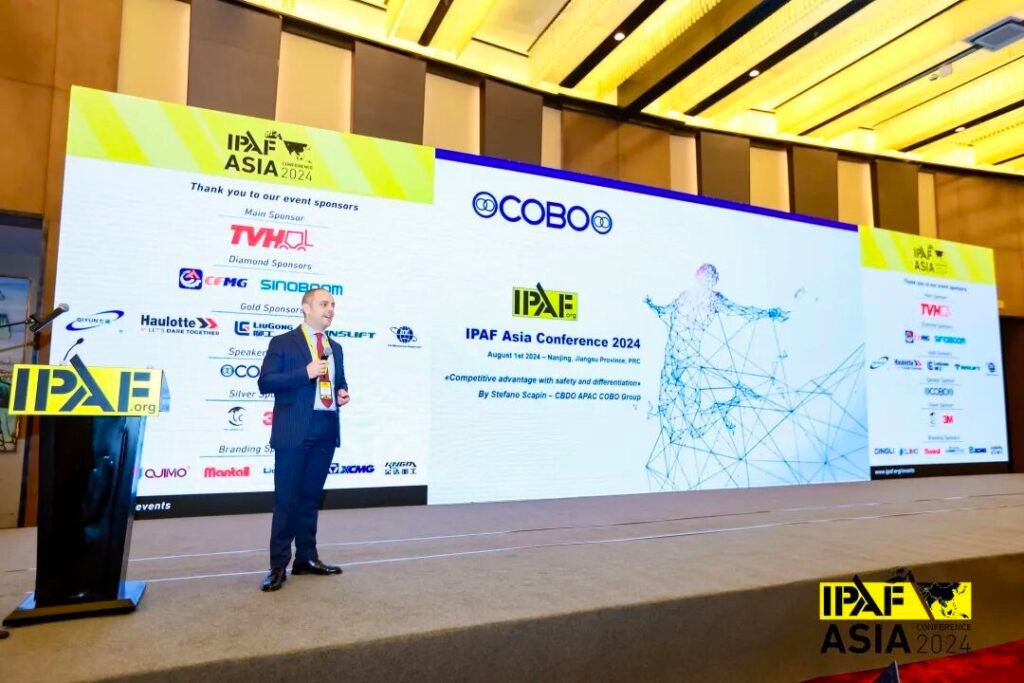
Stefano Scapin
During the 2024 IPAF Asia Summit, COBO Group’s Asia-Pacific Chief Business Development Officer, Stefano Scapin, shared his industry insights on topics including the internationalization of Chinese manufacturers, the EU’s new machinery regulations, the Indian market, localized manufacturing in Mexico, and opportunities in the telescopic forklift market.
在2024年IPAF亚洲峰会期间,蔻博COBO集团亚太区首席业务发展总裁Stefano Scapin分享了对于中国制造商国际化,欧盟新的机械法规,印度市场、墨西哥本地化制造,以及伸缩臂叉装车市场机遇等话题的行业见解。
In terms of technological trends as well as international trade agreements and barriers, the automotive industry has always served as a reference point for the mobile machinery sector. Although there are fundamental differences between mobile machinery and automobiles in terms of scale, regulatory frameworks, and development models—and most automotive companies have not ventured into mobile machinery—the automotive industry still acts as a “barometer” for assessing the current landscape and future direction of the mobile machinery sector.
Punitive measures such as anti-dumping tariffs initiated by the United States and the European Union may undermine international trade and economic cooperation. However, from another perspective, they could accelerate the localization of Chinese products in Europe and North America. A number of Chinese manufacturers have already established localized operations in Mexico and Eastern Europe. It is expected that in the next one to two years, more international expansion initiatives by Chinese enterprises will emerge. As competition intensifies, opportunities for mergers and acquisitions may also arise.
The next U.S. presidential election, scheduled for November 2024, could potentially reshape the development trajectory of Chinese-made products manufactured in Mexico—many of which target the world’s largest rental market, the United States.
As the world’s most populous country, India is projected to surpass Japan and Germany by 2027 to become the world’s third-largest economy. As such, India represents a strategically significant investment destination. Although India’s aerial work platform rental market remains relatively small (with fewer than 15,000 units) and lacks comprehensive safety regulations, and its growth may not match the rapid pace seen in China, the market is expected to triple in size over the next five years. Moreover, with deep involvement from European aerial work platform manufacturers in localized production, India is likely to adopt safety standards aligned with those of Western countries. In addition, India’s comparatively low manufacturing costs make it an increasingly attractive export hub.
Dramatic changes of our time are accelerating, making it impossible to view today’s industrial development through outdated perspectives. Take China’s automotive industry as an example: in recent years, it has transformed from a “follower” into a leader in innovation within the mobility sector. The internet has become deeply embedded in Chinese society, generating profound impact. Meanwhile, China’s intelligent electric vehicles are redefining the premium digital experience in the automotive industry.
China’s construction machinery industry underwent a major shift about a decade ago. Chinese companies overtook international brands in domestic market competition and began accelerating their globalization efforts. Leading players such as XCMG, Zoomlion, and Sany Group have accumulated years of experience in overseas markets. After establishing dominance at home, Chinese manufacturers are now actively expanding their global footprint. With the implementation of EU anti-dumping tariffs, they are expected to gradually develop and refine regional supplier systems—for example, vehicles manufactured in Europe will increasingly require components produced within Europe. Regionalization is becoming the new expression of globalization.
In contrast, in the field of agricultural machinery manufacturing, Chinese producers have so far made limited breakthroughs in overseas markets. Although some Chinese brands pursued acquisitions and established regional R&D teams, many withdrew prematurely without maintaining a firm long-term globalization strategy. By comparison, Indian manufacturers have made significant progress in agricultural machinery—particularly in the 100-horsepower mid-sized tractor segment. By integrating internationally recognized brand components, they are now capable of designing and producing products with technology and quality approaching European standards, while maintaining stronger price competitiveness. As a result, they have secured a meaningful position in the global market.
时代的巨变正在加速,因此不能以原有的视角看待当下的产业发展。例如,中国的汽车产业,过去几年,正在从“追随者”转变成为移动出行行业创新的领导者;互联网已经融入中国的社会生活,产生了深远影响;又如,中国的智能化电动汽车,正在重新定义汽车产业的高端数字体验。The rapid development of China’s construction machinery industry has also driven the growth of its component suppliers. When I first came to China in October 2014, there were only a handful of electronic component and solution providers. Over the past decade, however, the competitive landscape of China’s supporting industries for construction machinery has undergone a profound transformation. I have great respect for the speed of China’s development and the achievements it has accomplished.
With a 75-year history in the mobile machinery sector, COBO has consistently focused on the design and manufacturing of components and integrated solutions. We do not simply supply “finished products”; instead, we engage deeply from the early stages of a project—working closely with manufacturers’ engineers to understand both customer and end-user needs. By leveraging hardware and software architectures that comply with the world’s most stringent safety standards and enable efficient control of vehicle movement and functions, we develop solutions suitable for global markets.
COBO’s product portfolio includes, but is not limited to, ECUs, displays, control handles, sensors, and telematics systems. Through the seamless integration of hardware and software, we meet the requirements of different vehicle types and machine models, while helping customers reduce the time and investment required for new product development and validation.
中国工程机械产业的快速发展,带动了零部件供应商的成长。当2014年10月我第一次来到中国时,电子元器件与解决方案提供商还寥寥无几。但十年间,中国工程机械配套产业的竞争格局发生了转变。对于中国的发展速度以及所取得的成绩,我深感敬意。
蔻博COBO集团总部

In 2023, COBO achieved a global revenue of approximately $350 million, serving over 4,000 active customers worldwide, of which 80% are vehicle OEMs. The company has established deep collaborations with leading enterprises across the mobile machinery sector, including construction equipment, agricultural machinery, aerial work platforms, ground support equipment, fire trucks, and municipal vehicles. In addition, COBO continues to introduce its latest technologies to strategic markets such as the “high-end” automotive components segment, with these advanced solutions gradually being applied across the company’s core business units.
COBO operates 11 manufacturing facilities worldwide, seven of which are located in Italy, with additional production and assembly plants in the U.S., Brazil, Romania, and China. Looking ahead, the company plans to establish an assembly and testing center in India, further deepening its presence in this strategically important market.
The company has also built local teams in France, Germany, India, and Australia covering sales, marketing, logistics, after-sales service, and software application development. By delivering customized solutions, COBO leverages opportunities in both OEM integration and aftermarket services, effectively serving existing and potential customers at both global and regional levels.
2023年,蔻博COBO全球营业额约3.5亿美元,全球范围拥有4000多个活跃客户,其中80%来自车辆原始设备制造商。公司已经与建筑设备、农业机械、高空作业平台、地面保障设备、消防车和市政车辆等移动机械行业头部企业开展了深入合作。此外,面向汽车行业的“高端”配套领域等战略市场发布最新技术,这些先进的技术也正在逐步推广应用到公司的核心业务板块。The EU Machinery Regulation 2023/1230, which will replace 2006/42/EC, is set to come into effect in January 2027. Across all industries, machine safety remains the foremost concern, and the regulation aims to protect workers and assets while minimizing downtime and liability risks.
The new EU Machinery Regulation addresses several key areas:
-
Safety components now include software;
-
The regulation covers safety risks associated with artificial intelligence (AI) and the Internet of Things (IoT);
-
Requirements for cybersecurity are established.
In the future, mobile machinery such as aerial work platforms will increasingly move toward electrification and intelligent connectivity, with a stronger focus on safety. The new standards and regulations also provide space for technological innovation. Over the next two years, manufacturers and suppliers will need to prepare proactively, building unique competitive advantages and accumulating capabilities in technology and innovation to become key drivers of industry transformation.
欧盟机械法规2023/1230将取代2006/42/EC,于2027年1月生效。无论哪个行业,机器安全都是最值得关注的课题,法规旨在保障工人和资产的安全,最大限度地降低停工时间和责任风险。1、安全部件的定义涵盖了软件;
2、法规涵盖了人工智能和物联网所带来的安全风险;
Driven by demand for infrastructure upgrades and renovations, the global telescopic forklift market remains robust, particularly in the world’s largest market, the United States. The two largest U.S. rental companies—United Rentals and Sunbelt Rentals—collectively operate fleets exceeding 60,000 telescopic forklifts.
While the European telescopic forklift market is smaller than that of the U.S., it features a larger number of manufacturers. For example, in Italy, there are at least three sizable manufacturers, one of which collaborates with a U.S. manufacturer to supply rotating telescopic forklifts. European companies offer both construction and agricultural telescopic forklifts, and some have recently launched fully electric models.
In China, telescopic forklifts remain an emerging segment. A few aerial work platform manufacturers have already invested in production and sales of telescopic forklifts, primarily targeting export markets at present. It is expected that in the future, telescopic forklifts will gradually replace traditional truck-mounted cranes in China, thanks to their multi-functionality and versatility.
Rotating telescopic forklifts, in particular, are more complex products compared with scissor lifts and boom lifts. Chinese manufacturers could explore global technology partnerships or acquisitions to better define product positioning and accelerate time-to-market.
On August 1, 2024, Stefano Scapin, Chief Business Development Officer for COBO Group Asia-Pacific, delivered a keynote speech at the IPAF Asia Summit held in Nanjing, Jiangsu Province, China, titled “Competitive Advantages Behind Safety and Differentiated Development.” In his address, he shared unique insights into the current trends and future outlook of the aerial work platform industry.
得益于基础设施更新改造需求的推动,全球伸缩臂叉装车市场需求依然强劲,尤其是在全球最大的美国市场。美国两大租赁公司,联合租赁和Sunbelt租赁总计伸缩臂叉装机机队规模超过60000台。蔻博COBO:把脉全球产业,顺应技术潮流,用安全与创新引领变革